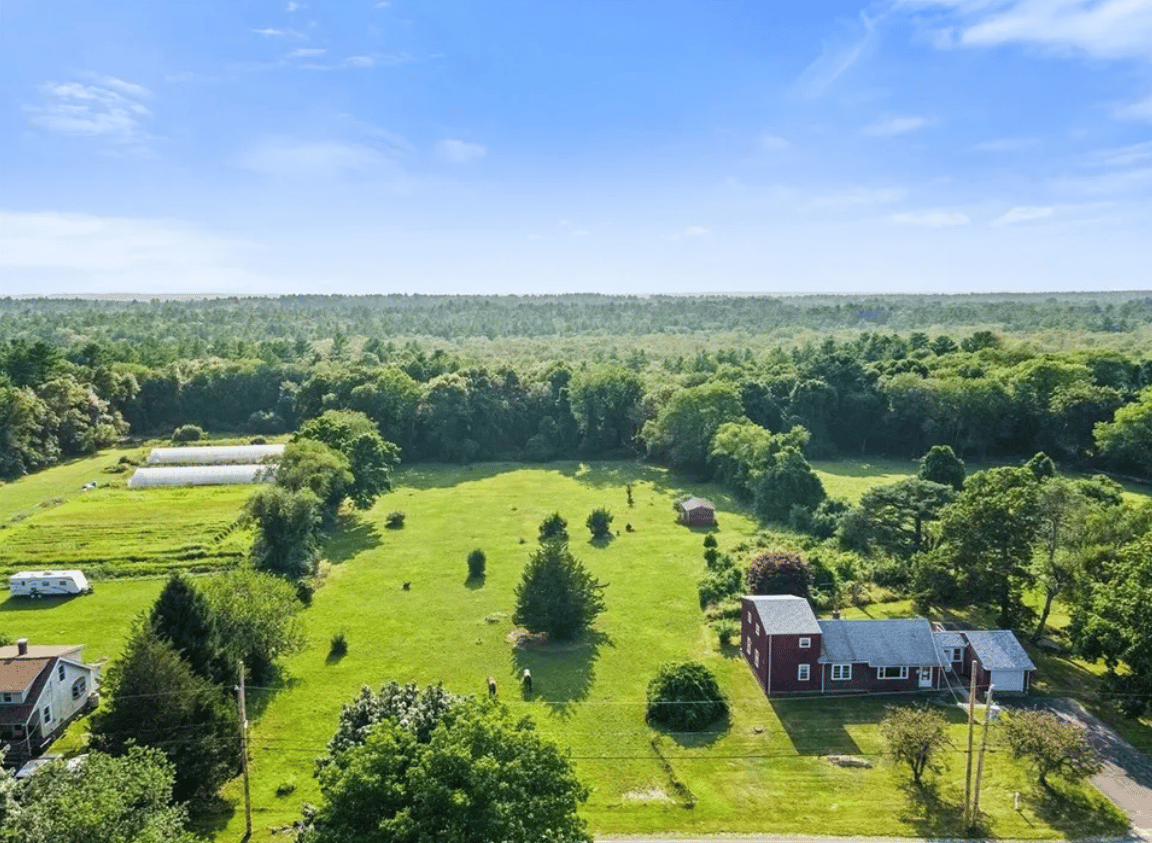
Drive down Cecilia Terrace in the Round Hill neighborhood of Sagamore this fall and you'll pass a run of boarded windows and no-trespassing signs on houses that, as recently as January, had families living in them. The state has spent the past eight months clearing this small pocket of Bourne to make room for a new Sagamore Bridge, and as of late August 2026, twelve of the thirteen homes marked for the taking had already changed hands, according to reporting from Cape and Islands NPR. The thirteenth is tied up in probate court over a death in the family, not a dispute over the taking itself.
If you're weighing property anywhere near this stretch of town, the headline number, thirteen homes, is the easy part to find. The harder question, and the one that actually determines what your money buys, is what the state's compensation covers and what it quietly leaves for the neighbors to absorb on their own.
What $2.1 Billion Buys, and Whom It Pays
The Sagamore Bridge replacement is a $2.1 billion project, and Massachusetts eminent domain law requires the state to pay property owners "reasonable compensation" for what it takes. In practice, that has meant closings for thirteen homes, seven vacant parcels, and seventeen partial acquisitions, where MassDOT takes a slice of a larger lot rather than the whole thing. As of April 2026, the state had taken eleven residential properties in Round Hill and paid the owners of six, with a running tab north of $4.8 million and climbing, according to the Boston Globe.
That figure includes more than the sale price. Massachusetts eminent domain compensation is built to cover relocation and closing costs alongside the fair market value of the parcel itself. Luisa Paiewonsky, who runs the megaproject delivery office at MassDOT, put it plainly to NBC Boston: the agency owes displaced owners "full compensation," on top of respect and sensitivity for what the move costs them personally.
For Phillip Michaud, whose 80-year-old mother's deed transferred to the state in January, the money never touched the actual loss. "That's what's tough about eminent domain," he told Boston.com. A tight-knit street where neighbors shoveled each other's driveways for decades doesn't survive being scattered to different towns, no matter how the check is calculated.
The House That Wasn't Taken
Here's the part of the story that matters most if you're not on the taking list. Dave Collins lives on the west side of Round Hill, in a house his father-in-law built and named after his own children. MassDOT hasn't taken his home. His house isn't listed among the thirteen, the seven vacant lots, or the seventeen partial acquisitions. And yet Collins told the Globe his home, assessed at $621,000, is now effectively unsellable at that number. "You couldn't give it away right now," he said.
That's the mechanism worth understanding before you buy or sell anywhere near this project: compensation only reaches the parcels the state actually takes.
- Homes fully taken (13): compensated, closings underway since January 2026
- Vacant parcels taken (7): compensated
- Partial-acquisition parcels (17): compensated for the portion the state takes
- Neighboring, non-taken homes: not compensated, regardless of how close they sit to the future staging area, the equipment routes, or the years of construction ahead
A house that keeps its full lot and its full ownership still has to compete for buyers against the knowledge that cranes, concrete mixers, and heavy trucks will be running through the immediate area for years. Nothing in the eminent domain process addresses that, because legally, nothing was taken from that owner. The value damage is real. The compensation isn't.
Vacant Homes, Real Risk in the Meantime
The gap between taken and untaken hasn't stayed theoretical. With most of the Round Hill homes already emptied and boarded, MassDOT has reported squatting and break-ins on the vacant properties, according to the same Cape and Islands report. Paiewonsky said the state has moved to board up the homes and post no-trespassing signage specifically out of concern for "the neighbors who are remaining in the neighborhood whose homes were not taken." MassDOT now plans to demolish the acquired homes and has told residents to expect a neighborhood meeting within four to six weeks of that late-August announcement to walk through demolition and construction plans.
For anyone holding property that abuts this footprint, that's a period of real exposure that predates the actual bridge construction: empty, unsecured structures next door, months before a single beam goes up.
Two Bridges, Very Different Timelines
Not every corner of Bourne carries this risk in equal measure, and the distinction is worth knowing if you're comparing neighborhoods rather than fixated on one street. The Sagamore side is the active one. Construction on the new bridge is expected to start in late 2027 or 2028 and run into the late 2030s, per the Cape and Islands reporting, and the land acquisition that supports it is almost finished.
The Bourne Bridge side is a different story entirely. As of early 2026, NBC Boston reported that only one home was under threat of eminent domain for that project, and the Bourne Bridge replacement remains unfunded and in preliminary design. MassDOT officials told the Globe they expect to take "much, much less" land there than they did for Sagamore, though they haven't put a number on it yet. If you're looking at property near either span, that funding and design gap matters. One project is actively displacing families and reshaping a neighborhood right now. The other is still a plan on paper.
There's also a lesson here for anyone doing pre-purchase homework near either bridge. Marc and Joan Hendel built a new colonial in Round Hill in 2024, only to receive their eminent domain notice a few months after moving in. "We did everything we could, but nothing in our research mentioned the bridges," Marc told NBC Boston. Megaprojects of this scale don't always show up in a standard property search, especially years before land acquisition becomes public.
What This Means If You're Buying or Selling Near Round Hill
If a property you're considering sits anywhere near the Sagamore side of Bourne, a few questions are worth asking before you write an offer or sign a listing agreement:
Where does this parcel sit relative to MassDOT's taking map, and is it adjacent to a partial acquisition or the planned staging area? A house two streets away from Round Hill carries a different risk profile than one that shares a property line with it.
How is a lender's appraiser likely to treat proximity to an active, multi-year construction zone? Comparable sales inside an active taking footprint are thin by definition, and an appraiser working from older comps may not fully price in a neighborhood mid-transition.
What's the realistic timeline of exposure? Based on current reporting, that's not a matter of months. It's late 2027 or 2028 through the late 2030s for construction alone, on top of the acquisition and demolition period already underway.
Even where Massachusetts disclosure law doesn't require it, a straightforward conversation about proximity to the project tends to serve both sides of a transaction better than silence, particularly given how visible this story already is in local and statewide coverage.
A Few Questions Worth Asking Directly
Will more homes in Round Hill be taken? Based on current reporting, the take list for the Sagamore side is set: thirteen homes, seven vacant parcels, and seventeen partial acquisitions. If a property isn't in one of those categories, it isn't part of the current plan, though the Bourne Bridge project on the other side of the canal is still in preliminary design and hasn't finalized its own acquisition needs.
Does living next to the taking zone mean my home will eventually be taken too? Not necessarily. Dave Collins's home is a direct example of a property that sits inside the affected neighborhood without being on the taking list, which is exactly why the value question is separate from the compensation question.
Is the risk the same on the Bourne Bridge side of town? Not right now. Only one home has been flagged for eminent domain there, and that project remains unfunded, according to reporting as of early 2026.
Bourne is still the town that gets you the canal, the boating, and a shorter commute than the deeper Cape. This particular corner of it is also, for the next decade, a construction zone with a documented history of eminent domain that reaches further than the compensation checks do. If you're evaluating a property near Round Hill or Sagamore, or trying to figure out what a comparable listing there is actually worth given everything above, Susan Gorden Ryan Luxury can walk through the specifics with you. Request a complimentary home valuation and get a read on your property that accounts for what's happening next door, not just what's listed on the deed.